
Service Details
Designing a solar-powered electric pump system in Kenya involves technical, environmental, and regulatory considerations tailored to the country’s agricultural and water needs.
Below are the key requirements for system design:
1. Site Assessment
Water Source Evaluation: We assess the water source (e.g., borehole, well, river, or dam) for depth, flow rate, and water quality. Boreholes in Kenya typically range from 20–200 meters deep.
Solar Irradiance: We use Kenya’s high solar potential (5–6 kWh/m²/day) to estimate energy availability. Tools like local weather data (from Kenya Meteorological Department) can provide accurate projections.
Site Conditions: We evaluate terrain, shading (e.g., from trees or structures), and accessibility for installation and maintenance, especially in remote areas like Baringo or Garissa.
2. Water and Energy Needs Analysis
Water Demand: We determine daily water requirements (m³/day) based on application (e.g., irrigation for 1–10 hectares, livestock watering, or community supply). For example, drip irrigation may require 20–50 m³/day per hectare.
Pump Specifications: We calculate the total dynamic head (TDH), which includes the vertical lift, pipe friction losses, and pressure requirements. Kenyan boreholes often require submersible pumps with high TDH (50–200 meters).
Energy Load: We estimate the pump’s power requirements (kW) based on flow rate and TDH. Typical pumps range from 0.5 kW (small surface pumps) to 10 kW (large submersible pumps).
3. System Components
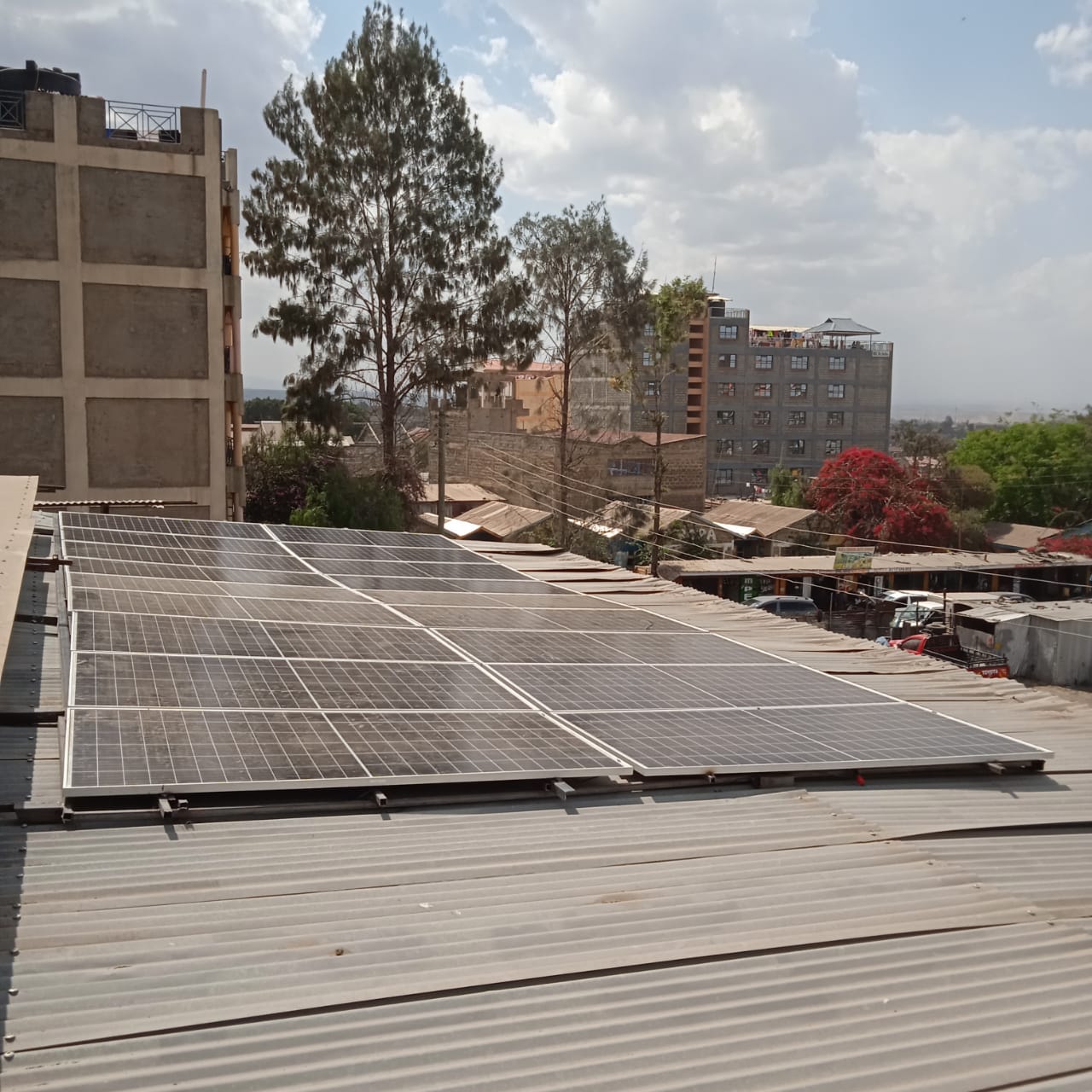
Solar Panels: Select monocrystalline panels for efficiency in space-constrained sites or polycrystalline for cost savings. Size the array to meet the pump’s power needs (e.g., 1–10 kWp for most agricultural pumps).
Pump Type: Choose between submersible pumps (for boreholes/wells), surface pumps (for rivers/dams), or booster pumps (for pressurized systems like drip irrigation). Brands like Grundfos or Lorentz are common in Kenya.
Controller: Include a solar pump controller to optimize pump performance and protect against dry running or overvoltage. Variable Frequency Drives (VFDs) are often used for larger pumps.
Mounting Structure: Use corrosion-resistant mounts suitable for Kenya’s climate (e.g., coastal humidity in Mombasa or high winds in Turkana).
Battery Storage (Optional): Include batteries (e.g., lithium-ion) for nighttime pumping or cloudy days, though most solar pumps operate during daylight hours to minimize costs.
Monitoring System: Integrate remote monitoring (e.g., via GSM or apps) to track pump performance and water output.
4. System Sizing and Design
Panel Sizing: Size the solar array to provide 1.2–1.5 times the pump’s power requirement to account for inefficiencies and cloudy days.
Pump Selection: Match the pump’s flow rate (m³/h) and head (meters) to the application. For example, a 2 kW submersible pump can deliver 10–20 m³/h at 50–100 meters head.
Piping and Storage: Design piping systems to minimize friction losses and include storage tanks (e.g., 5,000–50,000 liters) for water buffering, especially for irrigation.