
Service Details
Requirements for Designing a Solar Industrial System in Kenya
Designing a solar industrial system in East Africa involves technical, regulatory, and environmental considerations tailored to the country’s unique conditions.
Below are the key requirements:
1. Site Assessment
Location Analysis: We evaluate the site’s solar potential using Kenya’s/ EA high solar irradiance data (average 5–6 kWh/m²/day).
Roof or Land Suitability: We assess roof structural integrity for rooftop systems (common in urban areas like Nairobi) or available land for ground-mounted systems (e.g., in rural industrial zones like Athi River).
Shading and Obstructions: We account for shading from nearby structures, trees, or dust accumulation, especially in arid regions like Kitui or Garissa.
2. Energy Needs Analysis
Load Profile: We analyze the industry’s energy consumption (kWh) and peak demand (kW) using utility bills or smart meters. East African industries often have high loads (e.g., 100 kW–10 MW for factories).
Critical Loads: Identify critical equipment (e.g., refrigeration for flower farms or machinery for manufacturing) requiring backup power via batteries or hybrid systems.
Future Expansion: Account for potential increases in energy demand due to business growth or new machinery.
3. System Components
Solar Panels: We use high-efficiency monocrystalline panels for space-constrained sites or polycrystalline for cost-effectiveness. Select Tier-1 brands (e.g., Jinko, Trina) with warranties of 25 years.
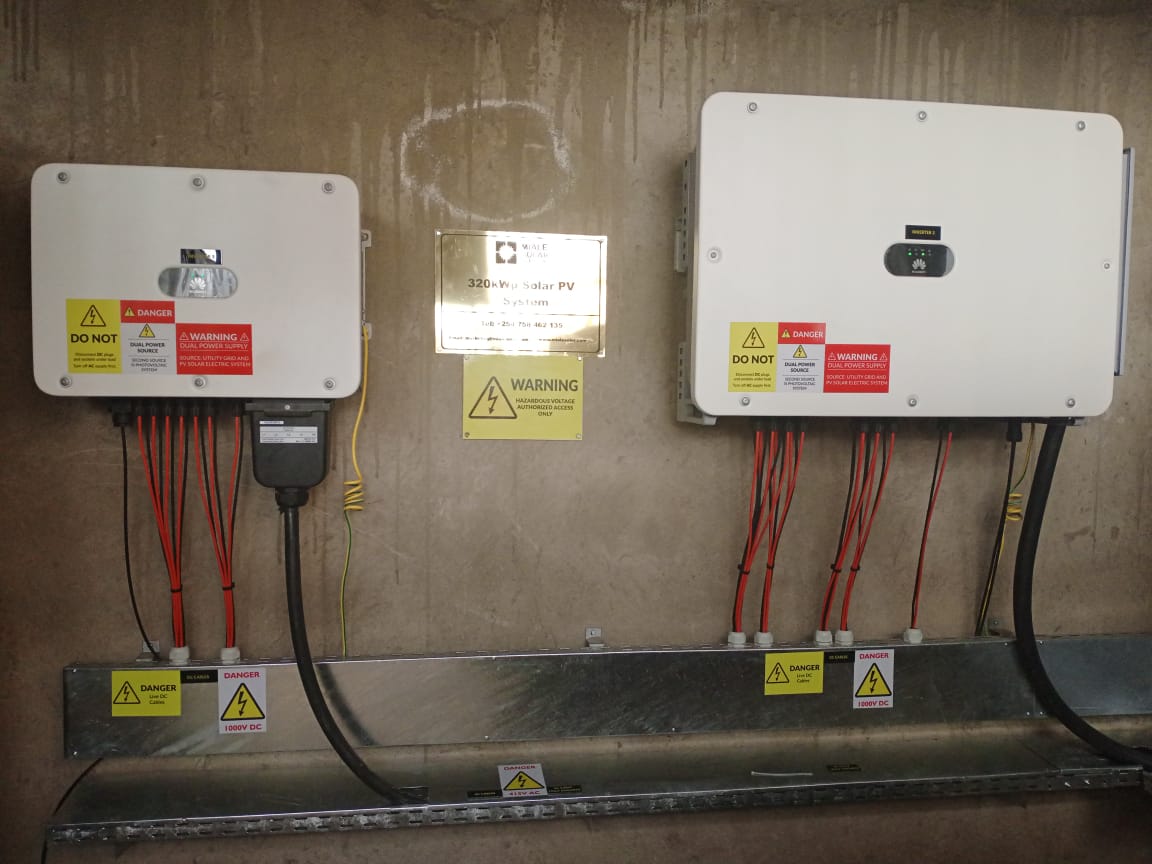
Inverters: We choose central inverters for large-scale systems or string inverters for smaller setups. Ensure compatibility with Kenya’s/ EA grid standards (240V, 50Hz).
Mounting Systems: Design for Kenya’s environmental conditions, including high winds (coastal areas like Mombasa) or seismic activity (Rift Valley). Use corrosion-resistant materials for coastal humidity.
Battery Storage (Optional): Include lithium-ion for backup power during frequent grid outages or for off-grid systems in remote areas.
Monitoring Systems: Integrate real-time monitoring platforms (e.g., via apps or web portals) to track performance and detect issues early.
4. System Sizing and Design
Capacity: We size the system to offset 50–100% of the industry’s energy demand, typically ranging from 100 kW to several MW for large factories.
Panel Layout: Optimize panel tilt (10–15° in Kenya due to proximity to the equator) and orientation (north-facing for maximum exposure).
Electrical Integration: We ensure compatibility with the facility’s electrical infrastructure, including transformers and switchgear. Design for single-phase or three-phase connections as needed.